
Cirris Core Modules
The Foundation for Flexible Testing
Cirris 5150 and 8250 testers are designed to be configurable, giving users the ability to tailor each system to their specific testing requirements. A range of High Voltage, Digital I/O, and Test Point module options makes it possible to adapt the system for different applications.
These configurations can support extended insulation resistance measurements, expanded automation capabilities, faster low‑voltage testing, integration of external instruments for higher measurement ranges and accuracy, and the ability to energize active components or devices during testing.
Cirris Core Modules are interchangeable, allowing a system to be modified as testing needs change. Systems can be reconfigured in the field with incremental updates rather than full replacements. This modular approach saves costs by enabling users to share modules across systems and add capabilities only when they are needed.

Core Scanner Modules

Advanced High Voltage Scanner Module
CM-AD64
Advanced High Voltage Scanner modules use mechanical relays for low‑voltage and high‑voltage testing. They include two relays per test point, allowing test points to float during HV testing—ideal for devices with multiple highly capacitive nets. Advanced modules also support optional external instrument integration (Keithley™, Keysight™, Agilent™, Chroma™ and more) and are the only test point cards that can be combined with Cirris Flex Point Scanner modules to provide energy for testing more active devices such as; relays, TVS Diodes, Zener Diodes, LEDs, Lamps/Bulbs.
Key Features
- Mechanical relays for LV and HV testing
- Two relays per test point for floating capability
- Supports optional external instruments
- Compatible with Flex Point Scanner modules
- 64 test points via two 96‑position VME connectors
Best For
High‑voltage test environments, complex assemblies, and systems requiring external instrument support.

High-Speed High Voltage Scanner Module
CM-HS64
High‑Speed Scanner modules use solid‑state relays for low‑voltage testing and mechanical relays for high‑voltage testing. This design enables faster low‑voltage test cycles and improved responsiveness during probing activities, reducing overall test time. High‑Speed modules cannot support optional external instruments or Flex Point modules.
Key Features
- Solid‑state relays for LV; mechanical relays for HV
- Faster LV testing for shorter cycle times
- One relay per test point (no floating capability during HV testing)
- Does not support HV High Cap function
- 64 test points via two 96‑position VME connectors
Best For
High‑volume production environments and applications prioritizing speed over advanced HV flexibility.

Flex Point Scanner Module
Coming Q3-Q4 2026
CM-FLX32
Flex Point Scanner modules combine Test measurement and External Energization capability in each point on the card. Each module provides 32 Flex Points. Users can add as many cards as needed in the system. Flex Point cards enable program‑controlled application of voltage from an external power supply (Optional) to the device under test (DUT).
Flex Point modules can be used as test points and energization points without the need of other test modules, or they can be installed alongside Advanced HV Scanner modules. This configuration allows the most flexibility in testing; providing Test and Measurement, Energization, and 3rd Party Instrument Integration for a wider range of voltage and measurement capabilities, all in the same system. Flex Point modules do not work with Cirris High‑Speed HV or Low Voltage Core modules.
Key Features
- Integrated test and energization capability
- Program‑controlled external voltage application
- Compatible with Advanced HV Scanner modules
- Ideal for relay testing and powering devices such as lights and fans
- 32 test points via one 96‑position VME connector
Best For
Applications requiring both electrical testing and energization, such as relay validation and functional component testing.

Low Voltage Scanner Module
Coming Q3-Q4 2026
CM-LV64
Low Voltage Scanner modules provide 64 test points per module and use solid state switching to maximize test speed. They support all low voltage test capabilities but cannot perform high voltage testing or support optional external instruments.
Key Features
- Solid‑state switching for maximum LV test speed
- Cannot perform HV testing
- Cannot support Flex Point modules or external instruments
- 64 test points via two 96‑position VME connectors
Best For
Dedicated low‑voltage test environments where speed and simplicity are key.
Core System Modules
High Voltage Module
CM-HV15 / CM-HV15-10G
High Voltage modules enable dielectric withstand (DW) and insulation resistance (IR) measurements at up to 1500 VDC / 1070 VAC. Two versions are available:
- CM-HV15 (Standard): Supports IR measurements up to 3 GΩ
- CM-HV15-10G (Optional): Supports IR measurements up to 10 GΩ
Key Features
- High-voltage DW and IR measurement capability
- Two performance options: 3 GΩ or 10 GΩ IR max
Required For
Applications requiring high-voltage insulation resistance testing of cables, harnesses, and other electrical assemblies.

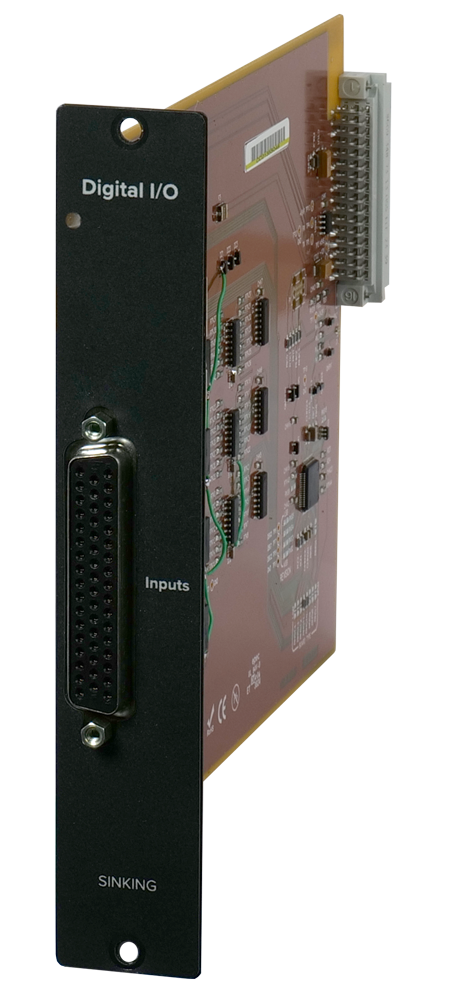
Sinking Digital IO Module
CM-DIOSK
The Sinking Outputs Module provides sinking (NPN) outputs similar to those found on Cirris testers such as CH2 and 8100. It offers programmable and dedicated channels for versatile control.
Specifications
- 20 programmable Sink Inputs/Outputs: 24 VDC
- 8 dedicated Sink Outputs: 24 VDC
- 2.24 mA max current per input
- 100 mA max continuous current per output
- Four relay channels: 2 A max
- Auxiliary power: +12 VDC at 100 mA, +5 VDC at 100 mA
Best For
Systems requiring NPN-style outputs for compatibility with existing Cirris testers or automation setups.
Sourcing Digital IO Module
CM-DIOSR
The Sourcing Outputs Module provides sourcing (PNP) outputs commonly used in automation environments for communication with PLCs. It includes both input and output channels for flexible control.
Specifications
- 16 Sink Inputs: 24 VDC, 2.24 mA max current
- 16 Source Outputs: 24 VDC, 250 mA max continuous current
- Maximum sample rate: 20 Hz / 50 ms (depends on communication method)
Best For
Automation systems requiring PNP-style outputs for PLC integration.


Installing a Module
Caution: The tester must be powered off before removing or installing system modules.
- Exit / close the Easy-Wire software.
- Power down the Base and all the connected Expansions by toggling the Power Switch on the rear panel to the OFF position or by using the switch on the power strip if one is being used.
- (8250 only) Remove the top and bottom rails by removing the four screws holding each in place.
- Remove the blank panel covering the position in which the new module will be installed or remove the existing module that will be replaced.
- Install the new module by placing the top and bottom edges of the printed circuit board(s) into the exposed, internal card guide(s) and carefully sliding the module into the unit until the connector(s) on the rear of the printed circuit board(s) fully engage. The new module’s front panel should be flush with adjacent panels.
- (8250 only) Reinstall the top and bottom rails using all four screws in each.
- When the unit is restarted, the new / replacement module will be automatically recognized.
